
The Tabernacle at Shiloh was meant to be a sanctuary — a place where burdens were lifted and prayers were heard. But for one woman named Hannah, it became the setting of both humiliation and divine breakthrough.
Her story in 1 Samuel 1 is not merely about infertility or answered prayer. It is about being misunderstood in your deepest pain — and discovering that even when spiritual leaders fail to see your heart, God never does.
So why was Hannah, a grieving woman, publicly misjudged by Eli the High Priest?
To understand the moment, we must step into her sorrow.
A Woman Carrying Invisible Grief
Hannah lived in a painful cycle of longing. She was unable to have children, while her husband’s other wife, Peninnah, not only bore children but continually provoked and mocked her. In that culture, barrenness carried social stigma. It was seen as shameful, even as divine disfavor.
Year after year, Hannah went to worship at Shiloh. Year after year, her pain deepened.
Finally, she reached her breaking point.
Instead of lashing out, arguing, or defending herself, she did something different — she poured out her soul before God.
A Silent Prayer That Looked Suspicious
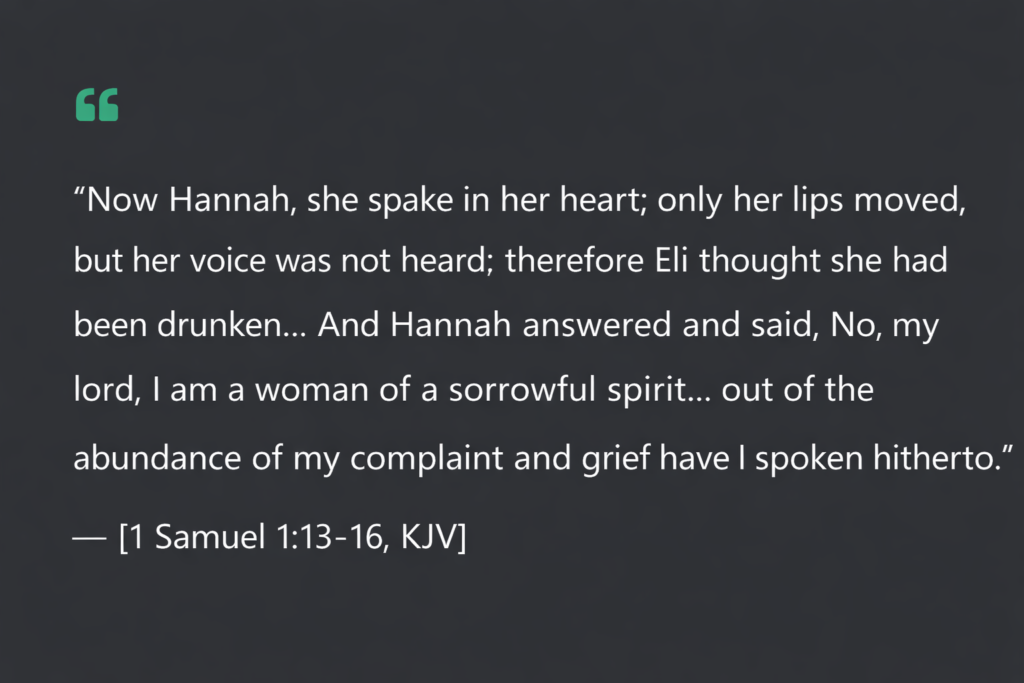
The Bible tells us that Hannah prayed silently. Her lips moved, but no sound came out. She was speaking from the depths of her heart — not in public performance, but in raw vulnerability.
Eli the High Priest observed her from a distance.
He saw moving lips.
He heard no words.
He made an assumption.
He concluded she was drunk.
“How long will you be drunk? Put away your wine,” he said (1 Samuel 1:14).
In a place meant for refuge, Hannah was publicly accused of disorderly behavior. At her lowest emotional point, she was misunderstood by the very spiritual authority who should have recognized sincere prayer.
Why did this happen?
1. Human Perception Is Limited
Eli’s judgment was based on appearance. He evaluated behavior without understanding context.
From his perspective, a woman muttering silently and swaying in emotional intensity seemed inappropriate. But what he misread as intoxication was actually desperation.
This moment reveals a timeless truth: even spiritual leaders can misinterpret what they do not fully see.
Eli was not malicious. He was mistaken.
Sometimes people respond to what they observe — not to what is actually happening inside someone’s heart.
2. Spiritual Leadership Can Grow Dull
The wider biblical story shows that Eli’s spiritual awareness was fading. Later chapters show his sons were corrupt and Eli became a weak leader.
His inability to discern Hannah’s prayer was not random. It reflected a growing spiritual dullness.
This doesn’t mean God had abandoned him, but it does show that position does not guarantee perception.
Sometimes those who sit closest to sacred spaces can become accustomed to routine and lose awareness of authentic spiritual hunger.
Hannah’s prayer was unusual — and unusual things are often misunderstood.
3. Pain Often Looks Messy
Deep grief rarely presents itself in neat, controlled form. Hannah was weeping bitterly. She was physically shaken by sorrow. She was not composed.
Authentic emotion can appear disorderly.
When someone is deeply broken, their expression may not match social expectations. To an outside observer, vulnerability can resemble instability.
But God does not measure prayer by volume or elegance.
He measures sincerity.
Hannah’s Response: Strength in Gentleness
What makes this story even more powerful is how Hannah responded.
She did not argue.
She did not lash out.
She did not shame Eli in return.
Instead, she respectfully explained:
“I am a woman full of sorrow… I have been pouring out my heart to the Lord” (1 Samuel 1:15).
Her calm clarity shifted the atmosphere.
Eli, realizing his mistake, changed his tone and blessed her. What began as accusation ended in encouragement.
This shows an important lesson: sometimes staying calm and honest fixes mistakes better than getting angry.
God Heard What Others Misheard
The central miracle of the story is not Eli’s correction — it is God’s response.
Hannah prayed silently.
Eli misunderstood.
But God heard everything.
Her whispered petition resulted in the birth of Samuel — one of Israel’s greatest prophets.
From the place of public embarrassment came a legacy that would shape a nation.
This is the deeper message of 1 Samuel 1: human misunderstanding does not cancel divine attention.
You may be misjudged in public.
You may be misunderstood in sacred spaces.
But heaven listens differently than earth does.
The Power of Silent Prayer
Hannah’s prayer challenges a common assumption: that louder equals stronger.
Her prayer was soundless — yet it shook history.
It reminds us that God is not limited to audible words. He understands internal language. He discerns thoughts and intentions.
When you can’t find the words… When you’re too tired to express your faith… When tears take the place of words…
God still hears.
Why Was She Insulted?
Let’s return to the central question.
Why was a heartbroken woman insulted by a man of God?
Not because she was wrong.
Not because she was sinful.
Not because she lacked faith.
She was misjudged because:
- Human vision is incomplete.
- Spiritual authority is still human.
- Deep pain can be misinterpreted.
- Authentic vulnerability does not always look polished.
Her insult became the doorway to testimony.
What This Means for Us Today
Hannah’s story resonates deeply in modern life.
Many people carry invisible struggles — infertility, career setbacks, private grief, financial stress, silent disappointment. They show up in places of worship, workplaces, and family gatherings carrying unseen burdens.
Sometimes, instead of kindness, they face misunderstanding.
This story assures us:
- Being misjudged does not mean you are unheard.
- Being misunderstood does not mean you are unseen.
- Being accused does not mean you are abandoned.
God operates beyond surface perception.
A Final Reflection
Hannah walked into the Tabernacle crushed. She walked out with peace — even before her prayer was visibly answered.
The Bible says her face was no longer downcast after Eli blessed her. The breakthrough began internally before it appeared externally.
Why?
Because she had poured out her soul — and trusted that God had received it.
The greatest comfort of this story is simple:
Even when the “man of God” misunderstands, God Himself understands perfectly.
And sometimes, the prayers that look weakest to others are the ones that change the future.
About the Author