
Pharaoh sat upon his throne, adorned with symbols of his claimed supremacy. Moses and Aaron approached—not with armies, but carrying a simple shepherd’s staff. This humble instrument became a sign from God. On command, Aaron threw it to the ground, and it transformed into a serpent. Pharaoh’s own magicians responded, producing their own serpents through secret arts. Yet, Aaron’s serpent moved with unmatched authority, swallowing every other serpent.
This story from Exodus isn’t just a biblical spectacle; it’s a clear message: imitation is no match for origin. Just as businesses today see competitors try to copy strategies, products, or branding, we learn that true power lies in the Source, not in the technique. Pharaoh’s sorcerers could mimic the miracle, but they couldn’t command its outcome.
The Devouring Sign: Aaron’s Staff Dominates
In ancient Egypt, the cobra symbolized the Pharaoh’s sovereignty. By allowing Aaron’s staff to consume the other serpents, God publicly dismantled the symbols of Egypt’s power.
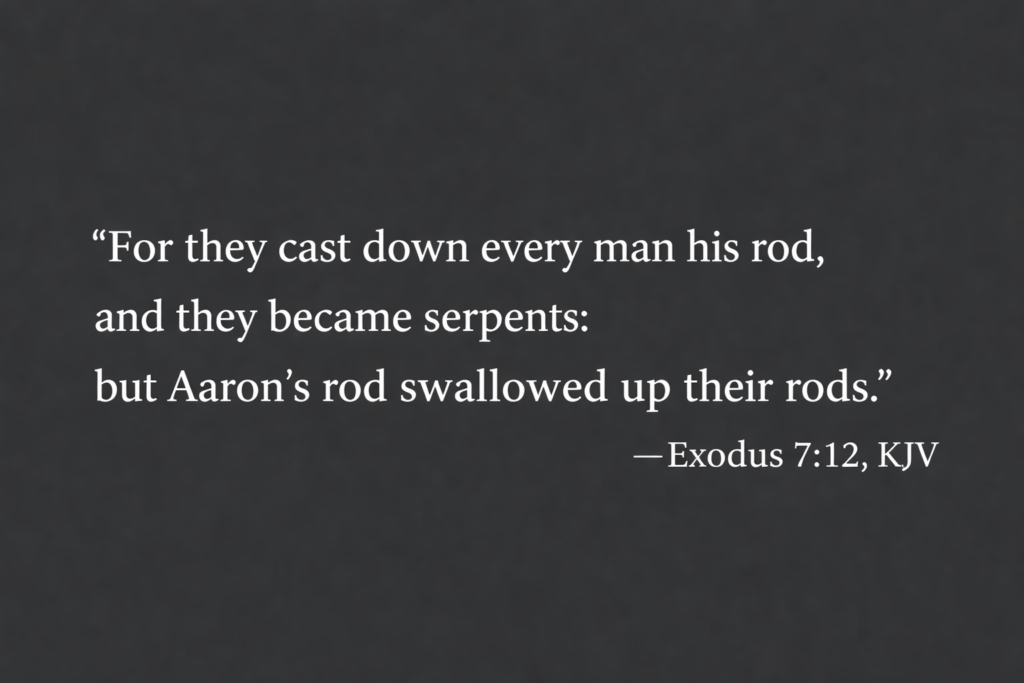
- Exposing False Authority: The magicians succeeded initially to show the limits of human skill versus divine power.
- Complete Victory: Aaron’s staff didn’t just compete—it removed all opposition, demonstrating that true authority surpasses imitation.
- Seeing Through Illusions: Pharaoh witnessed the “tricks,” but he failed to grasp the truth: only God controls the ultimate outcome.
3 Key Lessons from Aaron’s Staff
Return to Original Form: Once the serpents were defeated, Aaron’s staff became a staff again—proving God governs both form and function.
Sovereignty Over Imitation: Human tricks may replicate problems, but they cannot resolve them. God’s authority is the ultimate corrective force.
First Move in Deliverance: This was the opening strike of the Exodus, demonstrating that God restores confidence and control, even when human power feels overwhelming.
Lessons for Today: Handling “Copycats”
Entrepreneurs face modern-day serpents when competitors imitate ideas or products. Initially, it may feel defeating to see your hard work replicated, but the lesson mirrors Aaron’s staff: quality and authenticity, rooted in purpose and principle, eventually overcome imitation. Success isn’t measured by how well you guard against copies—it’s measured by alignment with the ultimate Source of power.
Why God’s Authority Remains Supreme
God doesn’t call us to outdo the world with flashy tricks; He calls us to trust Him and act faithfully. Pharaoh had his secret arts, but they were finite. God’s authority is infinite. When life feels full of intimidating challenges or imitators, remember the palace floor in Egypt: human skill has limits, divine authority does not.
Conclusion: The Staff Was the Word
The staff didn’t triumph because it was wood—it triumphed because it represented God’s Word and presence. Every false power, every act of imitation, every attempt to intimidate is limited. God’s authority prevails.
Ask yourself: what “serpent” in your life—false power, fear, or intimidation—is standing before you? Are you ready to hand it over and let God act?
Type “Amen” if you believe God reigns over every challenge, and declare: “You reign.”
About the Author