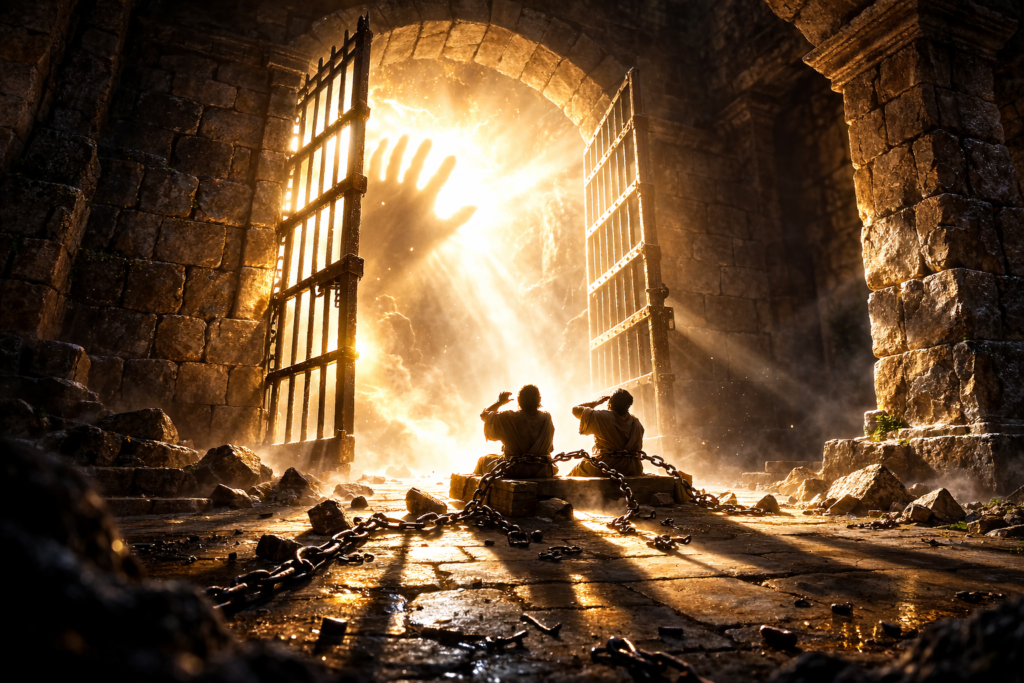
The inner prison in Philippi was cold, dark, and suffocating. Paul and Silas, after being stripped and beaten with rods, found themselves confined in the deepest, most restrictive cell with their feet bound in heavy stocks. From a worldly perspective, this was a moment for hopelessness and complaints. But at midnight, they chose a different response: they began to pray and sing praises to God. Suddenly, an earthquake shook the very foundation of the prison, causing all doors to open and every chain to fall off. But the real miracle wasn’t the opening of doors; it was that no one left.
In my experience navigating the competitive and often unpredictable world of business, I’ve seen my own “midnight moments.” I’ve built businesses like Gentleagu and SERISIMPLE and sat in boardrooms where the “earthquake” of an unexpected market change gave me the option to walk away from difficult partnerships. Yet, as we explore in Did Jesus Really Walk on Water? The Proof of His Divinity, sometimes God opens doors not for our own escape, but for someone else’s salvation.
The miracle in Acts 16 shows that true freedom is not about running away but about staying for the sake of others.
The Strategic Stillness: “We Are All Here”
The jailer, waking up to what seemed like a nightmare, saw all the doors open and assumed the prisoners had escaped. In Roman law, if a guard allowed prisoners to escape, he would be executed. In despair, he drew his sword, prepared to take his life. But then Paul’s voice rang out from the darkness: “Do thyself no harm: for we are all here.” This was a supernatural act of mercy—Paul not only spared the jailer’s life but also gave him the chance for salvation.
Why Did They Stay?
Had Paul and Silas fled, the jailer would have perished. By staying, they demonstrated that their freedom wasn’t tied to escaping their physical prison but to the peace in their hearts. The other prisoners, too, chose not to leave, captivated by the presence of God’s peace. This act of stillness and worship showed that Kingdom work often involves staying put, even when escape is possible, for the benefit of someone else’s salvation. God didn’t open the doors so Paul could run; He opened them to change the life of the jailer.
Three Hidden Truths About the “Midnight Miracle”
When we study Uncovering Ancient Bible Mysteries, we see that the Philippian prison break was more than a dramatic event; it was a turning point for the expansion of God’s Kingdom.
1. Worship as a Weapon
The earthquake didn’t happen when Paul and Silas were complaining; it happened when they were praising. God showed that the highest Kingdom productivity comes during the darkest times when we choose worship over fear.
2. The Sovereignty of the Chains
The earthquake loosed everyone’s chains, not just Paul’s. God often uses “unlikely containers” to bring about freedom. Just as the great fish became a vehicle of salvation, God uses situations that seem restrictive to bring His people to liberation.
3. The Immediate Harvest
That same night, the jailer and his entire family were baptized. The earthquake was the catalyst for an immediate harvest—proof that God’s divine intervention often has ripple effects beyond the immediate moment.
Managing Your “Open Doors” in 2026
I realized that “Kingdom Productivity” often means staying. We might feel paralyzed in the face of conflict, wanting to escape, but as we explore in The Meaning of “Selah” in the Psalms, the “pause” in the middle of open doors is often where we save someone else. In that moment, I chose to stay, solve the problem, and the business crisis turned into one of our strongest partnerships.
Why God Still Uses Your Life to Save Others
In our Daily Bible Verse and Prayer Guide, we learn that God isn’t so preoccupied with large-scale operations that He overlooks the individual. He is looking for hearts willing to sing at midnight, not perfect escape plans. If your life has been a series of “beaten” moments, remember the prison in Philippi. God may be opening a door for you right now—not to run from the pressure but to stay and become the solution for someone else’s crisis.
Conclusion: I Believe
Why did God open the prison doors? It wasn’t just about the doors or the chains; it was about the legacy of the Kingdom. God didn’t see captives in Philippi—He saw a Church. The chains were loosed not so the prisoners could run but so that the jailer could be saved. As we walk through our own “prisons,” we must remember: God opens doors not for our escape but for someone else’s salvation.
f you believe God uses your life to save others and you are ready to stay in the gap for someone today, type “Amen” and declare: “I believe.” Stop watching the doors and start watching the One who opens them.
What is the “open door” or the “midnight moment” you are facing right now? Are you ready to stop running and start reaching out to those around you?
About the Author